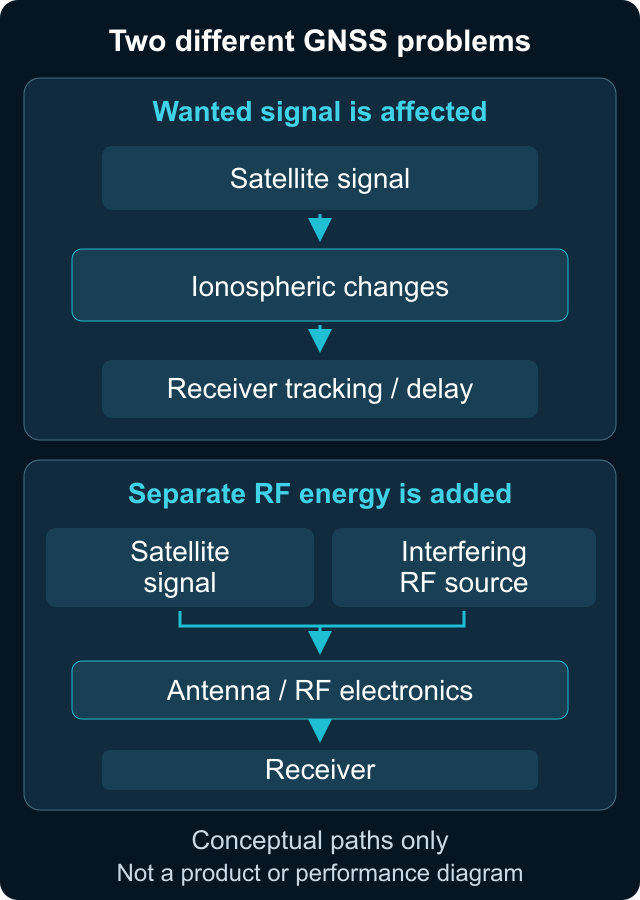
An anti-jamming antenna is not the right purchase solely because GNSS loses lock during ionospheric scintillation. Scintillation changes the satellite signal as it passes through the atmosphere. RF jamming adds interfering radio energy at the reception path. A mitigation system aimed at that RF energy does not, by itself, reverse an atmospheric disturbance already affecting the wanted signal.
For an outdoor machine or positioning-system integrator, the decision is whether to improve receiver tracking and positioning resilience, preserve correction delivery, protect against an identified RF source, or combine those scopes. A loss of fix in clear sky does not settle that decision.
Dual frequency corrects delay; it does not guarantee continued tracking
The NOAA explanation of space weather and GPS distinguishes ionospheric positioning error from loss of signal lock. Measurements at different frequencies help estimate the ionospheric delay. Under sufficiently disturbed conditions, however, a receiver may still lose lock, including in a dual-frequency system.
NOAA describes scintillation as rapid variations in signal power and phase caused by irregularities along the ionospheric path. This is why “dual-frequency,” “multi-constellation” and “anti-jamming” are not interchangeable guarantees. A purchase intended to address scintillation needs evidence about tracking and usable positioning under the relevant conditions, not just another band or an interference-suppression figure.
Use the pattern across signals, not one low signal-strength value
NovAtel’s software example compares carrier-to-noise ratio variation and lock time across satellites and frequencies, alongside RF observations and ionospheric activity. Rapid fluctuations across several signals with repeated loss of lock suggest a different investigation from degradation tied to a particular transmitter. Consistently weak reception may also have an installation or cable cause.
These are clues, not a universal classifier. Wideband RF interference can affect several signals, and more than one mechanism can coexist. A quiet interference indication does not independently prove scintillation. Use the selected receiver’s documented observations and time/location context together; a regional activity map is context, not a diagnosis of one installation.
Choose the part of the system that addresses the unmet requirement
Receiver tracking and positioning: compare documented resilience of the intended receiver and its enabled processing, including the supported observations and behavior when lock is lost. NovAtel’s resilience discussion identifies multi-frequency/multi-constellation tracking, positioning processing and additional sensors as complementary approaches. More observations can provide redundancy; they do not guarantee that every affected signal remains usable. An external anti-jamming unit is not evidence of those receiver functions.
Correction delivery: distinguish loss of correction messages from loss of satellite tracking. NovAtel’s support bulletin notes that ionospheric activity can also interrupt L-band augmentation reception and discusses Internet delivery where available. An Internet correction route may avoid dependence on that satellite data link, but it does not repair unusable GNSS observations. The chosen receiver and service still need to support the alternative route.
RF interference protection: when a separate RF source is part of the requirement, evaluate mitigation for the affected signals and reception path. NovAtel’s interference overview explains how an anti-jam antenna system uses its elements and electronics to reduce interfering energy from particular directions. That is a different intervention from correcting ionospheric delay or maintaining tracking through scintillation.
Example: the same loss of fix can produce two different shortlists
Hypothetical comparison, not a field result: a buyer sees intermittent loss of fix under open sky. Option A offers an external anti-jamming unit with a published RF suppression specification. Option B offers a receiver/navigation configuration with documented behavior under ionospheric disturbances.
If the supporting observations point to scintillation and do not establish an RF-mitigation requirement, option A’s suppression specification does not answer the unmet tracking requirement; option B is the relevant comparison, subject to its stated conditions. If an RF source is separately established, retain the RF-protection scope as well. Do not discard it merely because ionospheric activity is also present.
Where to go next
For a defined RF-interference purchase, use the ResiNav anti-jamming product catalogue to compare published configurations and reach the appropriate model enquiry. The catalogue does not establish scintillation mitigation, ionospheric monitoring or a tested combined navigation outcome. This distinction helps keep the ResiNav product request separate from additional receiver or navigation-system work.
If reception can disappear for longer than the system can tolerate, the GNSS outage-planning guide covers the separate navigation-aiding purchase. If the mechanism is still unresolved, retain the event context using the incident-triage guide rather than ordering from a loss-of-fix symptom alone.
NEXT STEP
Turn available platform information into an engineering review.
Use the Technology centre to frame the discussion, review relevant application scenarios, then send the available platform and receiver details for confirmation.