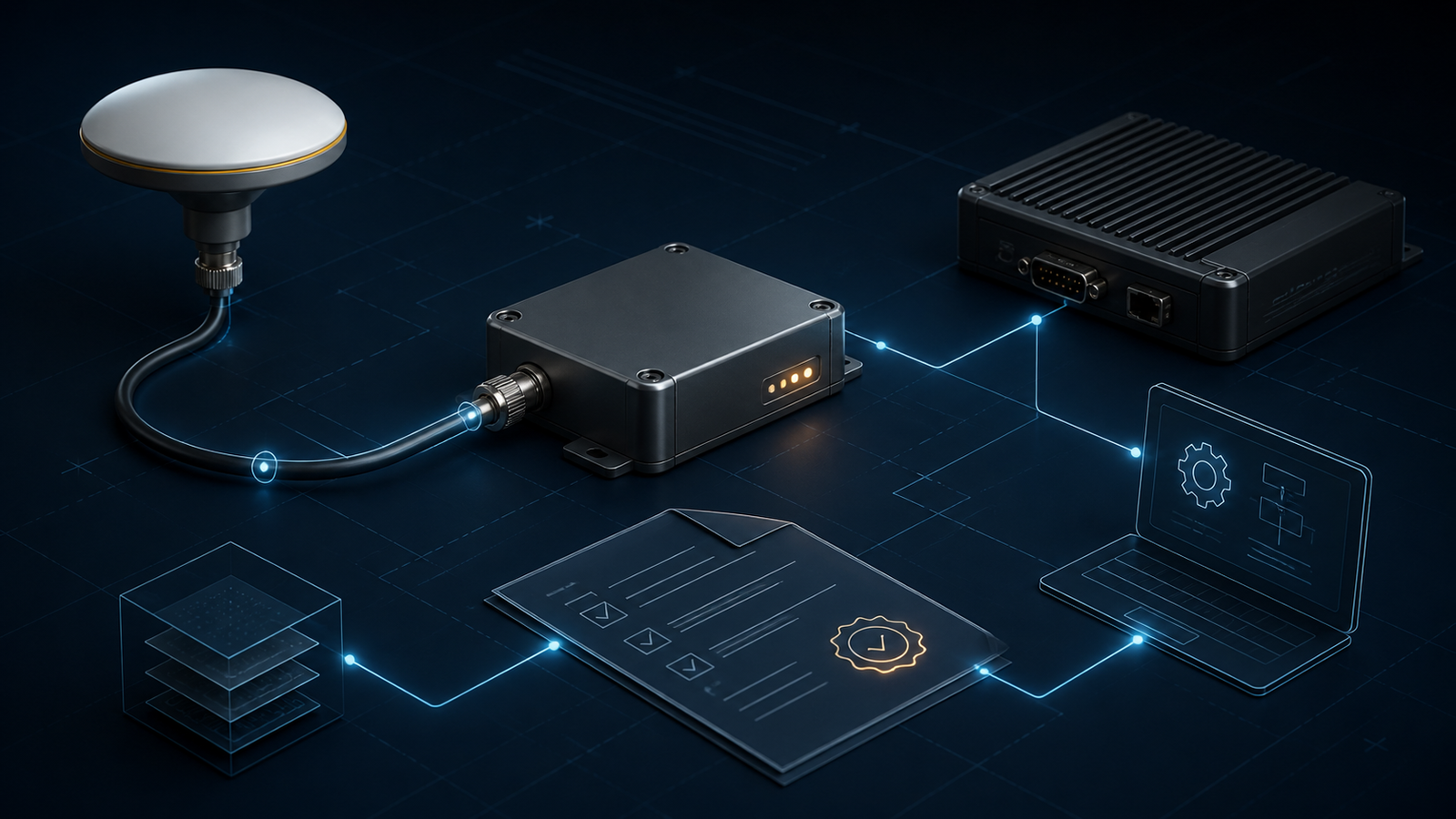
Before buying a longer cable or accepting a substitute RF assembly, check what changes between the product output and the receiver input. A traceable loss estimate can distinguish a documented alternative from an unresolved substitution; it cannot establish anti-jamming performance.
Why the RF path needs a traceable record
The antenna, cable, connector, adapter, filter, splitter or distribution device and receiver form one path. A record that identifies only the antenna model cannot establish whether later hardware changes, service work or cable substitutions altered the engineering assumptions used for the original review.
Documenting the path keeps engineering, procurement, installation and maintenance teams aligned. Each group can point to the same drawing revision, exact part number and unanswered question instead of relying on a verbal description of a “low-loss cable” or a “standard connector.”
Create an RF-path manifest
Create one controlled manifest for each receiver path. Link it to the applicable drawing, installation location and configuration revision. Include the following information for every inline item.
| RF-path item | Record before review | Evidence to retain |
|---|---|---|
| GNSS antenna | Exact model, output/interface details, mounting reference and drawing revision | Manufacturer documentation and current installation drawing |
| Cable assembly | Exact part number, actual routed length, cable revision and both end terminations | Supplier documentation, measured or controlled length record and assembly label |
| Connector or adapter | Connector series, gender, interface direction, adapter part number and intended location | Datasheet, assembly drawing and service record |
| Inline device | Filter, splitter, distribution device or protection device part number and placement | Manufacturer documentation and system schematic |
| Receiver input | Receiver model, input identifier and applicable interface-control documentation | Receiver documentation and project configuration record |
Use the current manufacturer documentation for the exact cable and component part numbers. Do not substitute an assumed loss-per-metre value, a generic connector description or a value copied from an unrelated platform.
Compare cable options at the same frequency and reference planes
A shorter cable is not automatically the right purchase, and a familiar connector does not establish an equivalent assembly. First identify the two reference planes: the documented RF output and the receiver input. For a passive path between them, add the cable attenuation at the frequency being reviewed to the specified insertion losses of connectors and inline devices. Keep every value tied to its exact part number and operating conditions. If an assembly specification already includes its end connectors, do not count those losses twice.
When comparing reflection specifications, the GNSS antenna VSWR and return-loss guide explains why the measurement plane and cable attenuation can change what a matching result means.
Illustrative arithmetic, not ResiNav specifications: suppose an assembly specification gives cable-only attenuation of 0.30 dB/m at the selected review frequency. The installed route is 8 m; the two terminations together contribute an assumed 0.40 dB and a protection device an assumed 0.60 dB. The estimated passive-path loss is (8 × 0.30) + 0.40 + 0.60 = 3.40 dB. These invented inputs demonstrate the calculation; substitute the actual supplier values before using it in a design or purchase decision.
| Illustrative option | Calculation at one review frequency | Procurement implication |
|---|---|---|
| Original 8 m route, cable A | 8 × 0.30 + 0.40 + 0.60 = 3.40 dB | Record this specific assembly and route, not simply “low-loss cable.” |
| Route extended to 12 m, same cable A | 12 × 0.30 + 0.40 + 0.60 = 4.60 dB | The path adds 1.20 dB of loss. Recheck the receiver input requirements; do not carry forward the old conclusion. |
| 12 m route, cable B at an assumed 0.18 dB/m | 12 × 0.18 + 0.40 + 0.60 = 3.16 dB | Lower calculated loss does not settle fit. Check bend radius, diameter, end fittings and installation conditions for cable B. |
Repeat the review for each required band using the corresponding attenuation data. Do not reuse a value from a different frequency or add an undocumented adapter with an assumed zero loss. A missing value leaves the budget incomplete; it does not establish that the component will fail.
A loss estimate is not an approval to add an amplifier
More LNA gain is not automatically a better cable-loss remedy. Separate the passive radiator’s directional gain (often stated in dBic) from the active antenna’s LNA power gain (dB). The first describes reception from a direction and polarization; the second amplifies what reaches the amplifier. A large LNA number cannot recreate a weak signal lost at the radiator. The u-blox GNSS antennas application note, revision R03, section 2.4 explicitly separates these figures and warns that excessive LNA gain can overload some receivers. Its numerical recommendations apply to u-blox equipment, not ResiNav.
For an active path, make a second calculation at each required frequency. If the antenna documentation states LNA gain at its RF output and there is no other active stage, the illustrative electrical gain from the LNA input to the receiver input is LNA gain − cable loss − inline-device loss. State the reference planes and whether connectors are already included in an assembly value. Do not add the radiator’s dBic figure to this conducted RF-input budget or treat the resulting number as receiver sensitivity, interference suppression or anti-jam performance.
Illustrative GPS L1 (1575.42 MHz) comparison, not a ResiNav or receiver-vendor specification: assume an active antenna LNA gain of 28 dB, 1 dB total inline loss, and a hypothetical receiver that accepts 20–35 dB of conducted input gain for this configuration. The cable and added amplifier figures below are planning assumptions. They show why the same receiver-input screen can lead to different purchases; they do not establish noise figure, blocker tolerance, power compatibility or field performance.
| Purchase option | Conducted gain at GPS L1, from LNA input to receiver input | Decision under the stated assumptions |
|---|---|---|
| Keep the long cable | 28 − 10 dB cable − 1 dB inline = 17 dB | Below the hypothetical 20 dB lower bound; retaining the present assembly fails this narrow input-gain screen. |
| Buy a lower-loss cable that fits the route | 28 − 4 dB cable − 1 dB inline = 23 dB | Inside the hypothetical range without another powered RF stage. Prefer this simpler path if its exact band losses, connectors, bend limit and installation fit. |
| Keep the long cable and add a 10 dB amplifier after it | 28 − 10 − 1 + 10 = 27 dB | Also inside the hypothetical gain range, but not equivalent to the cable change: the new stage cannot undo noise degradation before it and adds power, linearity and strong-signal questions. |
The cable replacement is the clearer first shortlist choice in this hypothetical case; an added amplifier is not justified merely because its arithmetic lands in range. Conversely, if the present chain is already near the receiver’s upper input limit, extra gain moves in the wrong direction. A receiver or antenna with different limits can reverse the decision. NovAtel APN-077 illustrates that OEM7 input-gain requirements vary with firmware and operating mode, while the u-blox note’s appendix shows why the location and noise figure of the first LNA matter. Those are manufacturer-specific examples, not limits for a ResiNav product or approval to connect a particular receiver.
For the noise mechanism behind this distinction, see how LNA position and cable loss change cascaded GNSS noise figure even when net conducted gain is unchanged.
Before placing an order, keep four items distinct: the selected radiator and its pattern, the active stage and its noise/linearity data, the specified loss of the actual cable and inline path at every required band, and the named receiver’s allowed input and antenna-power arrangement. If the required input range is met by a suitable cable, buy the cable rather than assuming more amplification is useful. If the route cannot change, compare a documented active-antenna or amplifier option only with its full RF and DC boundary. For a powered anti-jamming terminal, use its published RF output as the starting plane; do not apply this active-antenna example as if the terminal contained an interchangeable LNA.
Before ordering a substitute assembly, ask for the exact part number, end-to-end loss basis, required frequency coverage and physical installation limits. Then decide whether to retain the original assembly, evaluate the documented alternative, or leave the substitution open pending missing data. Use the public ResiNav datasheets to identify the proposed product’s documented output, not to infer a receiver-specific cable budget.
If nearby radios or platform operating modes also need investigation, use the adjacent-band interference guide alongside the RF-path record. Cable loss and the interfering environment are different review questions.
Treat these changes as review triggers
- Cable length, routing, part number or assembly revision changes.
- A connector is re-terminated, replaced or adapted.
- An adapter, filter, splitter, distribution device or protection device is added, removed or moved.
- The GNSS antenna, receiver model, receiver input or platform mounting arrangement changes.
- Installation, service or procurement records identify an uncertainty that cannot be reconciled with the approved configuration documents.
The purpose is change control, not administrative overhead. A small undocumented change can make a prior technical review difficult to apply to the installed platform.
If reception loss is driving a replacement order, use active GNSS antenna fault isolation to distinguish evidence for replacing the antenna from a cable, power or receiver-side problem.
When GNSS RF-over-fibre changes the order scope
Consider optical transport when the coaxial route or distribution to separated endpoints makes the existing loss budget unsuitable. It changes the transmission equipment you buy; it does not, by itself, answer an RF-interference protection requirement. In the ViaLite architecture below, the link carries GNSS RF, not decoded position, velocity and time (PVT) data.
ViaLite’s GNSS extension guide describes an antenna connected by coax to an RF-to-optical transmitter, a single-mode fibre link, and an optical-to-RF receiver connected to a time server’s GNSS antenna input. Here, “RF-over-fibre receiver” means the conversion endpoint, not the GNSS receiver that computes the navigation or timing solution. The transmitter supplies the active antenna’s DC feed. The optical receiver provides simulated antenna loading for the time server and can remove that load to indicate a link fault. Do not assume the original receiver-fed coax still powers the remote antenna or preserves the same fault indication.
A concrete scope example is the ViaLite VCS6FEK DS-5 parts list, page 2: transmitter, optical receiver, two power supplies with cords, RF jumpers and a 3 m fibre cable identified for bench testing. The bench cable is not evidence that the installed fibre route is supplied. This is a named kit for the documented Microchip arrangement, not a generic kit or a ResiNav-compatible configuration.
Hypothetical quotation comparison: assume a single antenna-to-equipment RF route, no reusable optical endpoint, and an RF-jamming protection requirement. These invented line-item summaries illustrate scope, not prices, performance or real offers.
| Purchase item | Proposal A | Proposal B | Purchase consequence |
|---|---|---|---|
| Conversion endpoints | Transmitter only | Transmitter and optical receiver | A leaves the receiving endpoint unpurchased. |
| Endpoint power | Not listed | Two endpoint supplies and cords | A leaves the powering arrangement unresolved. |
| Installed fibre | Not listed | Bench-test cable only | Neither summary includes the field route; specify its fibre and connector requirements. |
| RF-jamming protection | Not listed | Not listed | Neither summary supplies the requested protection function. |
B is more complete as a transport purchase, but not a complete protected installation. Adding only a longer fibre cable to A would not supply its missing conversion endpoint or power arrangement. Conversely, a buyer with an existing, approved endpoint would use a different assumption and should not buy a duplicate merely because this example uses a pair.
Power is architecture-specific. HUBER+SUHNER’s SYNCRO Max description uses Power-over-Fiber to supply the remote antenna through the optical connection. That differs from the separately powered ViaLite kit above. A quotation must identify the actual powering components; neither “fibre always needs a remote local supply” nor “fibre supplies power” is a sufficient specification.
The protection purchase remains separate from transport. ViaLite’s jamming-protection paper describes named Focus Telecom equipment placed between the antenna and optical transmitter, with a documented transmitter DC feed and antenna pass-through arrangement. This is evidence for that combined system, not permission to substitute any anti-jamming terminal into the same position or power it from the same port.
For a project needing both RF protection and a distant receiver input, compare the protection configuration and the transport configuration as separate deliverables. These are third-party transport examples, not ResiNav fibre products or approved ResiNav/optical-system combinations. RN2501’s published PVT/HDMI output is not evidence of an RF-over-fibre connection. Retain a receiver-input gain and, where relevant, timing-delay budget rather than treating the optical route as a zero-check replacement. For RF splitting after an optical endpoint, the GNSS splitter guide explains the separate branch-loss and DC-routing questions.
Make the cable decision explicit in the purchase record
Identify the original and proposed assemblies, the changed route length, the calculation or missing value, and the receiver requirement used for the decision. Ask whether the proposed substitution is accepted for this configuration, requires an evaluation, or remains unresolved. This is more useful than requesting an unspecified “better cable.” The worked figures above are illustrative only; the actual equipment documentation controls the review.
For an inline coaxial surge protector, use the GNSS surge-protector selection guide to compare DC continuity, protection ratings and order scope separately from the loss calculation.
Related engineering resources
- Antenna Placement for Industrial Robots and Automated Vehicles
- Resilient GNSS Receiver Evaluation Bench Tests
- Products
- Request a Quote
Frequently asked questions
Can a cable be described only as “low loss” for an engineering review?
No. The review needs the exact cable assembly or part number, actual or controlled length, connector/termination details, relevant documentation and its relationship to the receiver and antenna configuration.
Does replacing a connector require a new review?
It should be recorded as a configuration change. Whether further engineering review is required depends on the exact connector, termination, adapter use, affected interface and the current project documentation.
Can a cable change alone confirm or improve anti-jamming performance?
No. A cable change is one part of the RF path. Performance, compatibility and installation suitability require review of the complete documented system and applicable evidence.
When should an RF-path manifest be updated?
Update it whenever a listed path component, route, length, interface, receiver, antenna or supporting document revision changes, and whenever an open technical question is resolved.