APPLICATION SOLUTION / ENGINEERING REVIEW
GNSS Anti-Jamming Integration for Vehicle Platforms
For an existing vehicle platform, the first question is not “Which anti-jamming model has the most elements?” It is whether a published configuration can be evaluated against the receiver already installed, the required GNSS signals, the available mounting and power envelope, and the data consumed by the vehicle controller.
This page gives vehicle OEMs and integrators a practical screening path for a candidate product. It does not establish fit for a specific vehicle, autonomous-driving level, safety function or operating route.

Engineering context: Vehicle & Autonomous Systems is a conceptual application illustration. Confirm antenna placement, receiver interfaces, frequency bands, channel and array requirements, installation constraints and environmental conditions before selecting any candidate configuration.
SYSTEM ARCHITECTURE FLOW
Vehicle GNSS integration path
A generic engineering reference for documenting the GNSS signal path and platform integration boundaries. It does not represent a deployed customer system.
01
GNSS antenna
Placement, mounting envelope and signal environment.
02
Receiver / processing
Interfaces, channels, power and data requirements.
03
Mitigation review
Interference conditions and review constraints.
04
Vehicle controller
Platform interface, control boundary and installation review.
05
Fleet / navigation output
Documented navigation, survey, automation or system output.
Conceptual engineering reference — subject to engineering review.
Operational context and integration visuals

Operational Context: review the signal environment, mounting envelope, cable route and platform constraints. This conceptual illustration is not a customer photograph or deployment record.
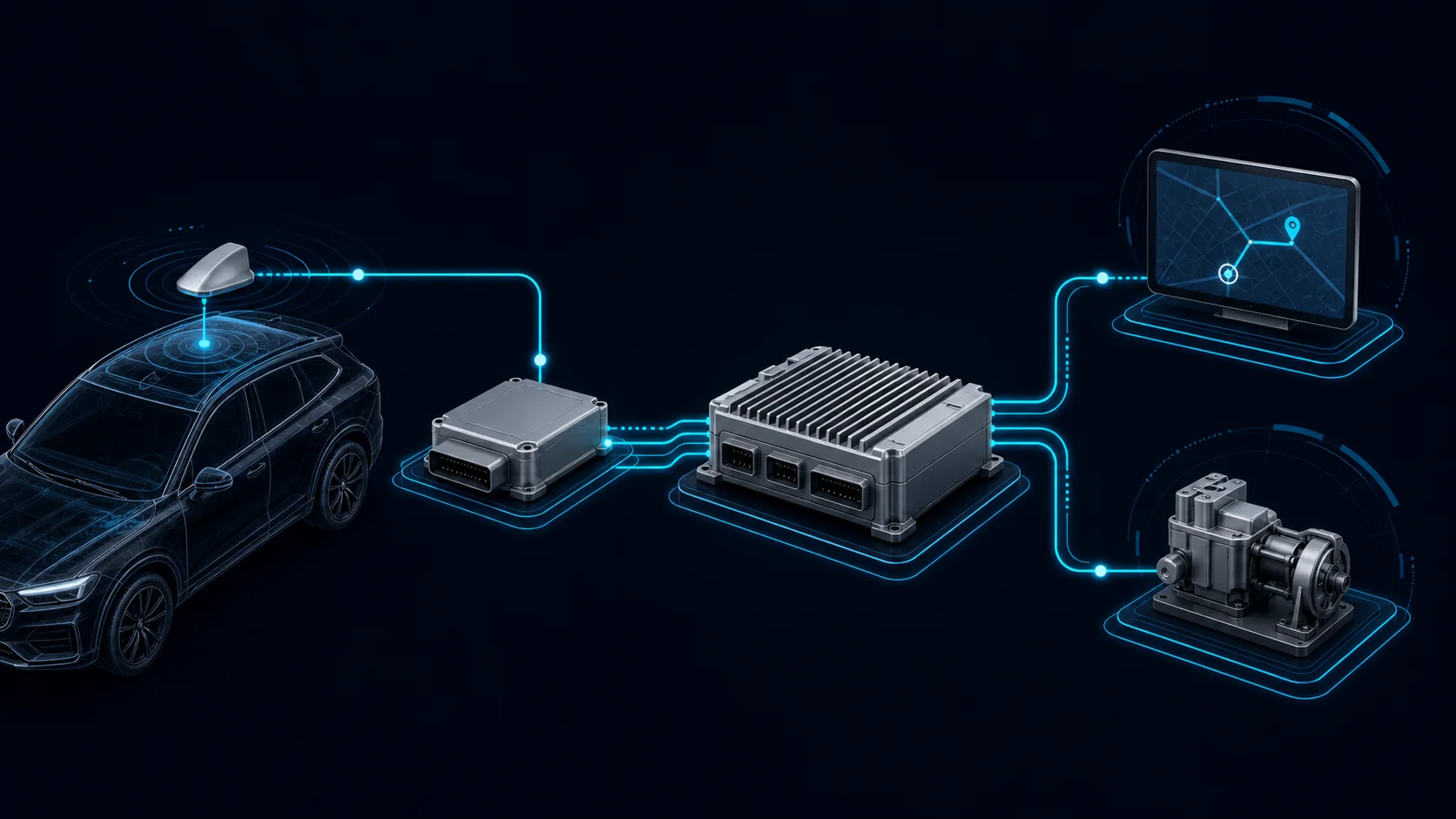
Reference Architecture / Integration: use this diagram to document antenna, receiver, platform control and navigation data relationships. Final suitability remains subject to engineering review.
Start with five fit gates on the existing vehicle
Record the installed condition before comparing model names. A “pass” below only means a product is worth an engineering review; it is not a vehicle qualification.
| Fit gate | Existing-vehicle fact | Published product fact to compare | If the answer is missing or mismatched |
|---|---|---|---|
| Receiver signal path | Receiver make/model, RF inputs and required constellations/bands. | Documented model signal support and product role. | Do not infer compatibility from a shared GNSS label; request an interface review. |
| Physical installation | Roof or mast drawing, clearances, vibration exposure and service access. | Published dimensions and weight, where available. | Keep mounting, cable and connector details open until drawings are confirmed. |
| Electrical integration | Available supply, protection, cabling and connector path. | Published power information and supplier-confirmed electrical interface. | Do not treat a power-consumption figure as an input-voltage or connector specification. |
| Navigation handoff | Receiver output, controller message format, status and timing needs. | Any documented product output or receiver-boundary information. | Controller validity, stale-data and fallback logic remain vehicle-system tasks. |
| Operating evidence | Representative routes, nearby emitters, obstruction transitions and acceptance owner. | Applicable supplier test record with conditions. | Do not convert a laboratory figure into field performance or autonomous-operation approval. |
Use published models as records to screen, not as vehicle endorsements
RN2501-AJS-4CH-DPA
The published independent anti-jamming and anti-spoofing version lists 4 antenna elements, 4 channels, BeiDou B1 and GPS L1. Its public record also lists a 150 × 130 × 22 mm body, weight ≤520 g and power consumption ≤13 W at normal temperature. Compare those exact published fields with your receiver and mounting envelope; connector, supply and vehicle-level fit still need confirmation.
RN2512-AJS-16CH-DPA
The published version lists 16 antenna elements, 16 channels, BeiDou B1 and GPS L1. It is another published configuration to consider during a model-specific engineering review. A higher element or channel count by itself does not establish better results on a vehicle or compatibility with an existing receiver.
These two examples do not exhaust the current product catalogue. If the receiver needs signals outside a model’s documented support, do not silently assume those bands are available. Ask for a different documented configuration or supplier confirmation.
For several platform variants, decide whether the candidate shortlists support one common model or separate enquiry lines.
Choose the next action from the evidence you have
| Current evidence | Appropriate next action | What not to claim |
|---|---|---|
| Receiver signals, platform drawing and power/interface requirements are documented; a model’s public fields align. | Request a model-specific engineering review with the existing receiver and mounting records. | Do not call the vehicle configuration approved before integration and test evidence exists. |
| Signal support appears relevant, but connector, supply, cable or software boundary is unknown. | Request the missing interface/drawing information before a price-led shortlist. | Do not infer pinout, input voltage or plug-and-play replacement. |
| The published model record does not state whether the required signals are supported. | Ask the supplier to confirm support for the exact configuration. If support is confirmed unavailable, review another documented configuration. | Missing published information does not establish either support or lack of support. |
| The route’s main issue is sky blockage. | Review antenna placement, obstruction transitions and fallback requirements at system level. | Do not promise that more antenna elements will resolve sky blockage. |
For heavy off-road platforms, continue with the engineering and mining vehicles guide. For generic receiver checks, see the receiver compatibility guide. The RFQ guide owns the detailed project brief; this page is the earlier platform-fit decision.
Take a candidate into an engineering review
Send the vehicle type and route, installed receiver model, required signals, installation drawing, power and connector details, controller data/status requirements, and the product record you want compared. ResiNav can identify which facts are already published and which require a model-specific answer. Bench, stationary-vehicle and route-level checks should then be planned against the actual system boundary, not assumed from the product category.
Questions before shortlisting
Can I choose a vehicle anti-jamming product by element count alone?
No. Compare documented signal support and architecture with the installed receiver, mounting envelope, electrical path and intended controller behavior. Element count alone is not a vehicle performance result.
Does a published BDS B1/GPS L1 configuration fit every vehicle GNSS receiver?
No. The receiver’s RF inputs, required bands, connectors, supply and navigation workflow must be verified for the particular vehicle.
Will an anti-jamming terminal guarantee autonomous operation when GNSS is lost?
No. The vehicle system must define data validity, timeout and fallback behavior; operational suitability and safety require separate system-level evidence.
For autonomous yard vehicles and outdoor robots, review the industrial robotics and automation GNSS integration guide when defining controller status handling and fallback behavior.